The Cultural Roots of Wine
Locally produced natural wine or transport-friendly wine? Wine's history has shaped our wine culture along both paths.

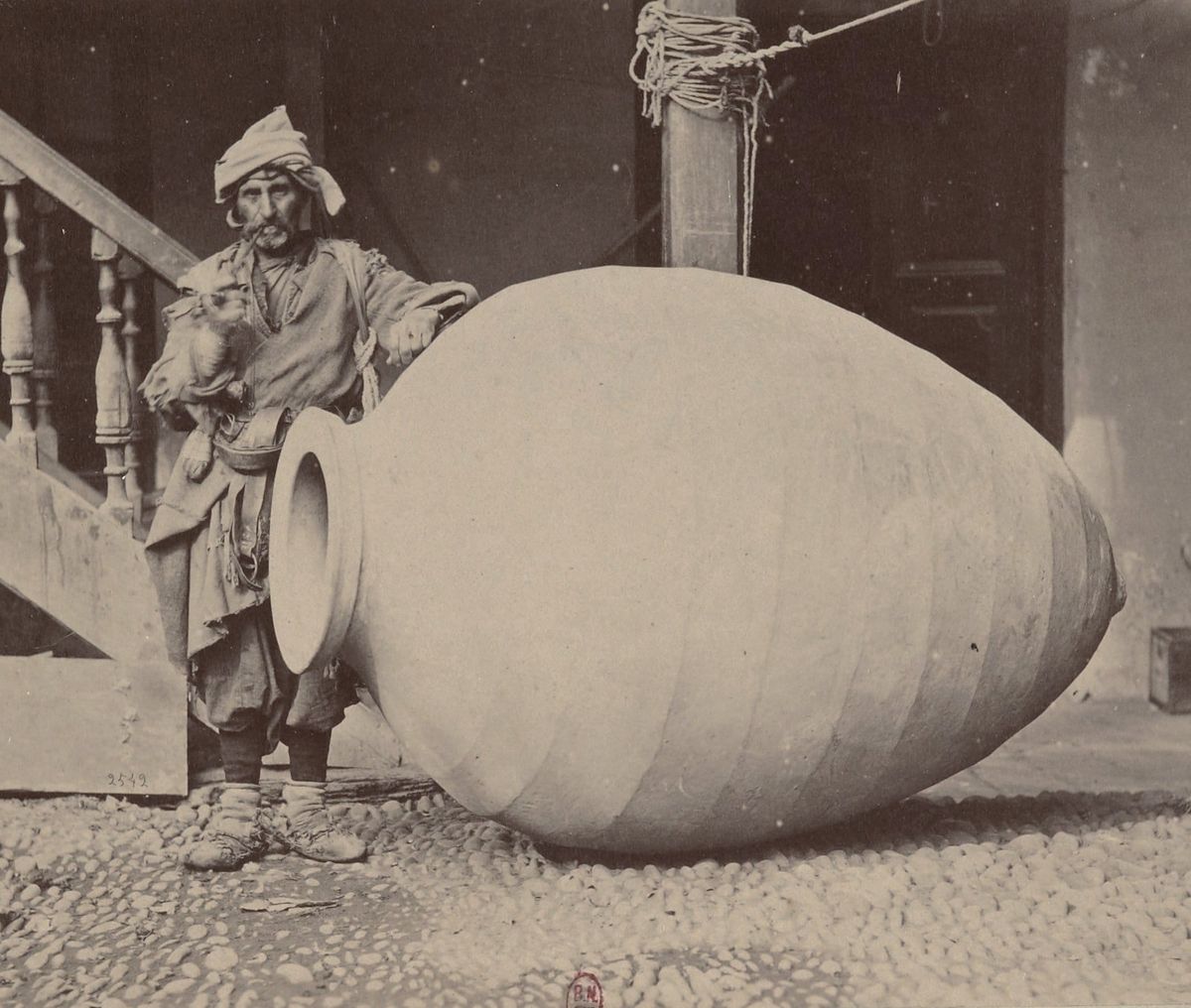
Without the people of the southern Caucasus approximately 8,000 years ago, we would not have wine as we know it today.
But we would also not have modern wine without the need to transport wine over long distances—a practice that the Phoenicians truly systematized around 3,500 years ago.
Together, these two currents in wine history created two distinct types of wine and thus two different kinds of wine culture existed until modern technology and global trade corridors changed the game.
But first let us begin in the southern Caucasus.
The Motherland of Wine
Here, the local population developed a technique of digging large egg-shaped clay vessels called “qvevri” into the ground, leaving only the opening exposed.
They aged the wine in these vessels with the skins for an extended period, resulting in mineral-driven, tannin-rich, and relatively earthy wines that expressed the quality of the grapes naturally growing in the area.
The region is located in Kakheti in the eastern part of present-day Georgia, bordering Azerbaijan to the east and Russia to the north.
The geography is highly varied, but in large areas it is characterized by a combination of deep river valleys and volcanic mountain peaks. This creates a microclimate where the contrast between warm, dry valleys and cool, breezy mountain slopes is perfectly suited to viticulture.
Close to Nature
Originally, wine production here began with some wild grapes, but over time humans cultivated grape varieties that ensured a stable and reliable yield.
One of them is a variety such as Saperavi, which is considered (although not yet confirmed) the original cultivated grape used for wine. It is a tannin-rich red-wine grape with thin skin, and its history is closely intertwined with the qvevri method, and both the grape variety and the fermentation technique are still in use in Georgia today.
Thus, the Kakheti region has not only provided the original grape varieties and the world’s oldest winemaking method. It has also given us a distinctive style of wine that has been exported to the entire world.
Take, for example, the natural wines, or orange wines, that have become popular in Europe. They closely resemble the style of the original Georgian wines, where we stay as close to nature as possible and process the wine no more than absolutely necessary.
Transport and Quality
By comparison, the vast majority of industrial wines today are designed to meet market taste preferences and only then put into production. Consideration for natural processes takes second place, because the wine can always be adjusted afterward if the weather does not behave as desired.
This brings us to the Phoenicians, because the principle corresponds very well to the way they are believed to handle their sweet Muscat wine around 1200 BCE in order to transport it by sea to their colonies throughout the Mediterranean.
They combined drying the grapes before pressing with the addition of pine resin to preserve the wine and seal the amphorae in which it was stored. This was a method widespread at the time, and the Phoenicians discovered it was particularly well suited for transporting wine by sea.
On top of that, they likely added honey and spices to mask the slightly vinegary taste that developed after a long journey along the Mediterranean coasts in summer heat. A method that became a sort of front runner for fortified wines such as Port, Sherry, and Marsala thousands of years later.
The Phoenicians’ primary goal was to produce wine for export. They were merchants with a well-established trade network across the entire Mediterranean, which they exploited to its full potential.
They did bring vine plants to their colonies so wine could be produced locally, but this was not systematized in the same way as their seaborne transport of wine.
In this way, the Phoenicians founded a wine culture centered on transport-friendly wine that, despite the flavor adjustments, aroused great enthusiasm among consumers of the time and became a trend throughout the Mediterranean.
Greek Takeover
It was not until the Greeks, during their expansive colonial period around 800 BCE, that local wine production was systematized across most of the Mediterranean.
The Greeks transformed seafaring in the region with their fast ships and simultaneously developed the amphora into a standardized transport vessel that was easy to pour from.
In this way, the Greeks succeeded in capturing the market for both transport-friendly wine and locally produced wine.
The innovation spoke for itself. The Phoenicians could not keep up, and when they simultaneously lost their independence as city-states to the Persians, combined with a general economic and political decline, it was game over. The Greeks gradually took over.
It was also the Greeks who, 400 years later, linked wine to philosophy, poetry, and social life—with all the cultural refinement that entailed, especially for the upper classes. Wine thus became synonymous with being a cultivated person.
Roman Scale
This overall model seemed sensible to the Romans around 100 BCE, so they adopted it and did what the Romans did best: scale it up.
In addition to building the famous Roman infrastructure across most of Europe, the Middle East, and North Africa—roads, aqueducts, and above all secure trade routes—they established enormous vineyards, first in Italy and later throughout the rest of the Roman Empire.
It is here that wine truly becomes the European culture we know today, combining locally produced wine with transport-friendly wine.
This was greatly aided by the Catholic Church, which took over most of the vineyards as the Roman Empire collapsed. In this way, the Church ensured both the continued production of wine and the preservation of wine culture right up to the Renaissance in the 16th century.
From that point onward, the nobility and powerful merchant families—such as the Medici in Florence—stepped in and took over the vineyards. This development continued all the way into modern times.
The Wine of the Future
When we look at today’s global wine market, the picture is a far more nuanced spectrum, with regional appellations, mid-range wines, and hybrid approaches to production made possible by modern technology and finely tuned trade corridors.
In other words, we have learned to preserve wine for transport while maintaining high quality. That is why we see many small producers being able to make premium regional wines that are both terroir‑focused and export ready.
The combination of authentic methods and technological development has thus moved wine into a new era, laying the foundation for the wine of the future—and where it will ultimately lead us is something we can only speculate about.
My personal angle
Personally, I consider myself lucky to be a wine lover today, since I wouldn't want to lose the ability to drink great wine from distant places.
I like my wines as close to nature as possible, but not at the expense of quality, so I guess I'm a direct product of modern wine culture in that regard.
I therefore think we should improve our technology and trade system even more to secure the consumption of locally produced quality wine anywhere in the world. I believe it makes us all better wine lovers and improves our quality of life.
None of it, though, would be possible without either the craftsmanship that grew out of the Kakheti region 8,000 years ago or the transport-friendly wine that the Phoenicians specialized in. Let's keep that in mind when we enjoy our next glass.