The Freedom to Be a Brush
The Baldi family was an organic pioneer in Piedmont long before it was popular, and for 33-year-old Gabriele Baldi, life as an organic wine producer continues to be a journey toward high-quality wines in close symbiosis with nature.
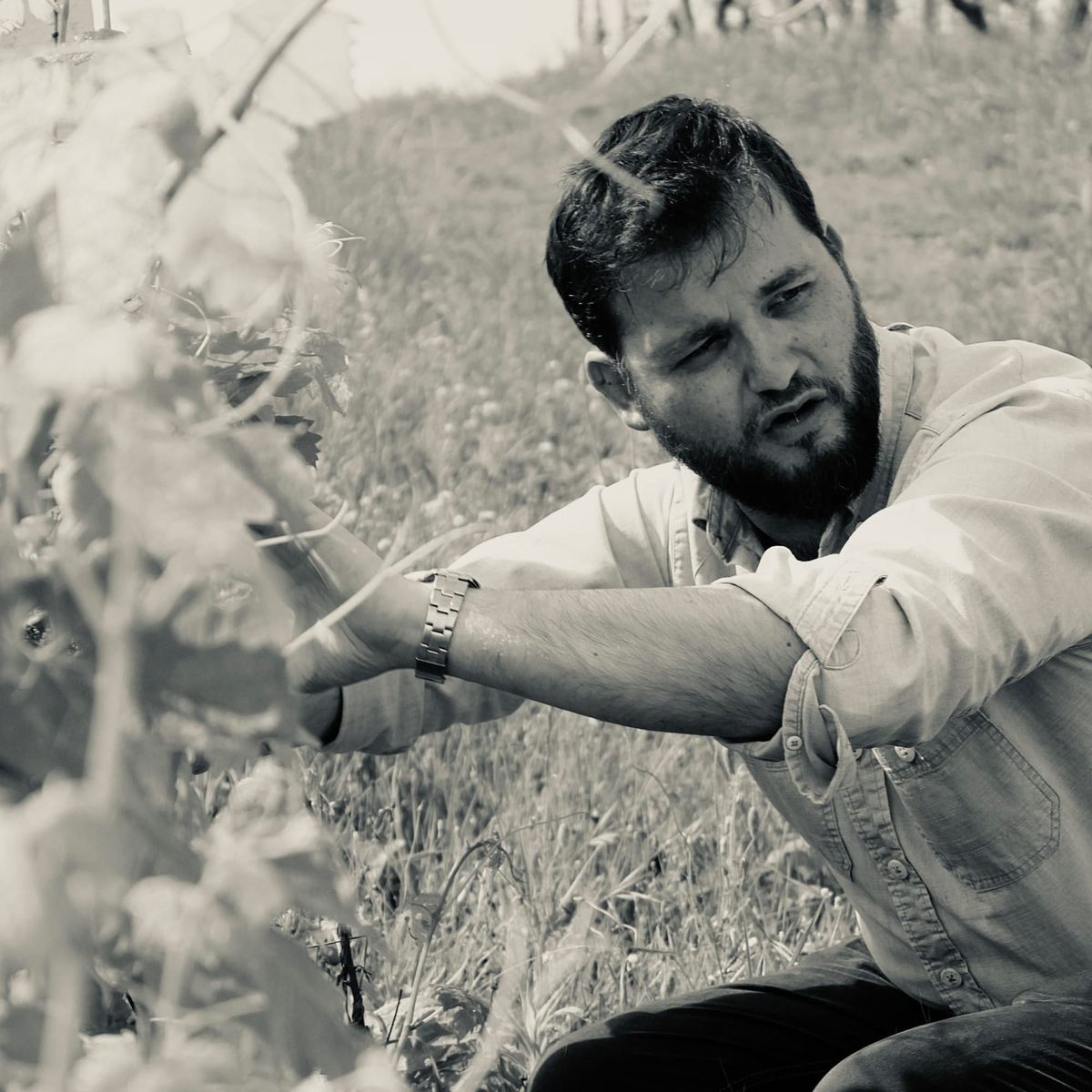
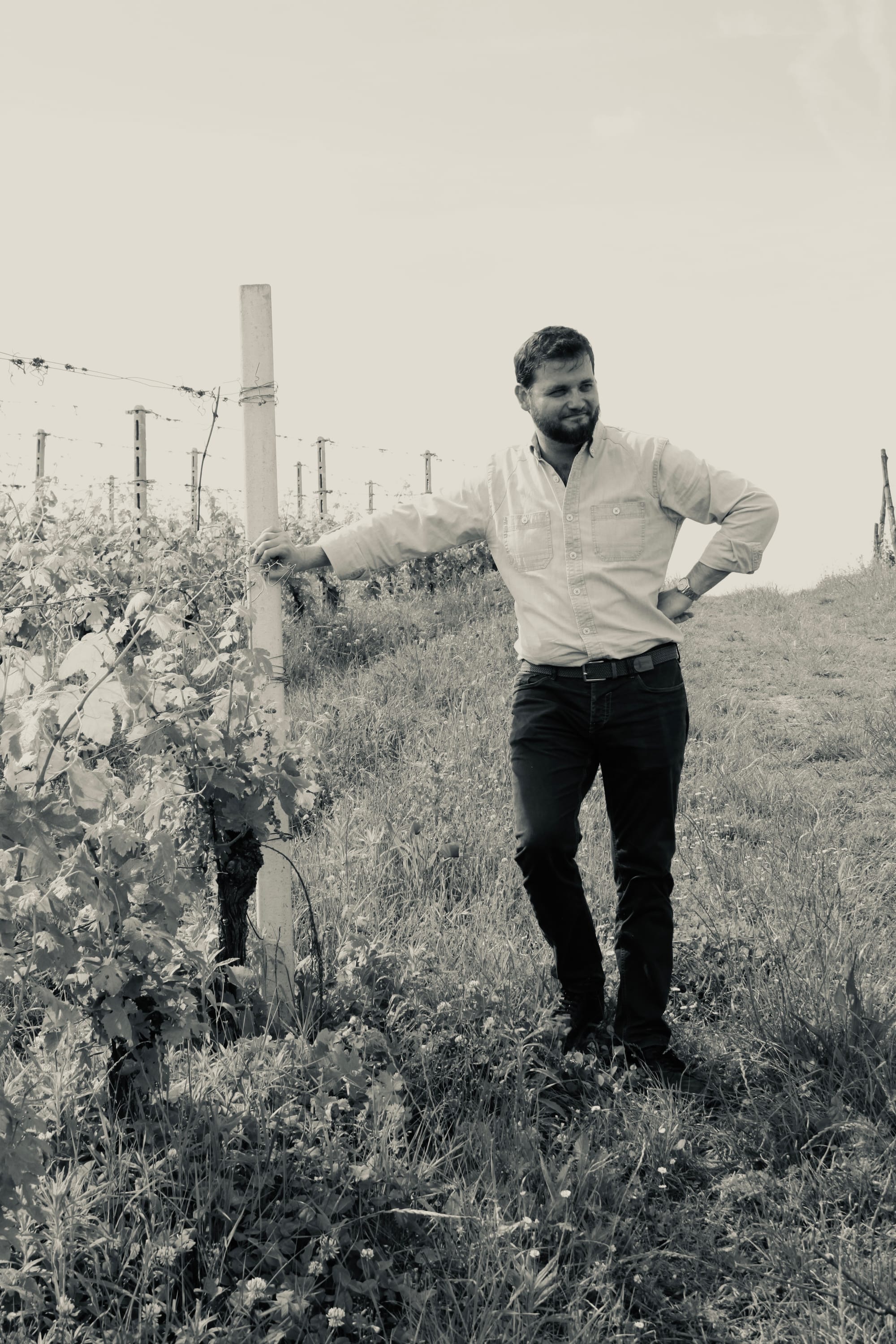
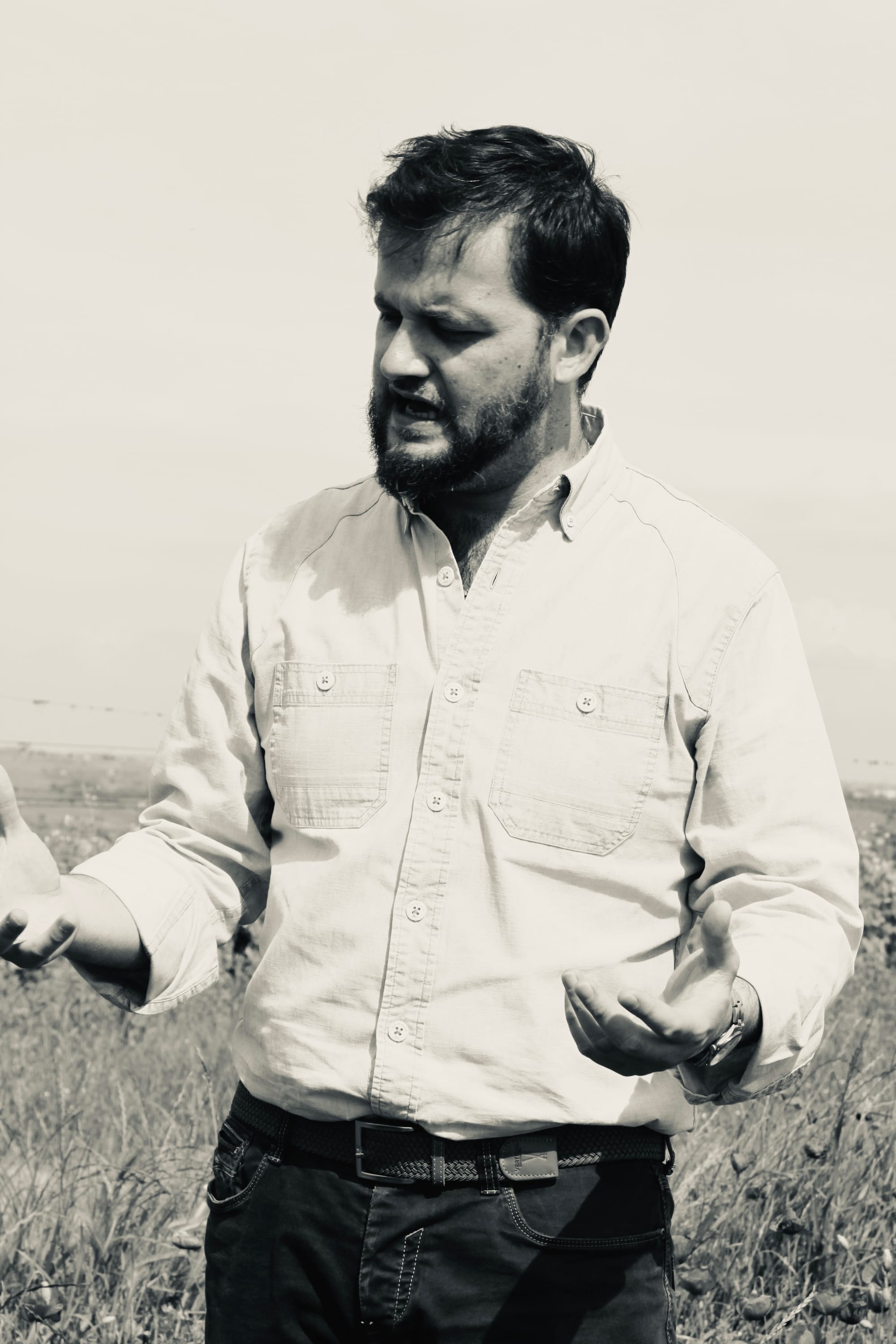
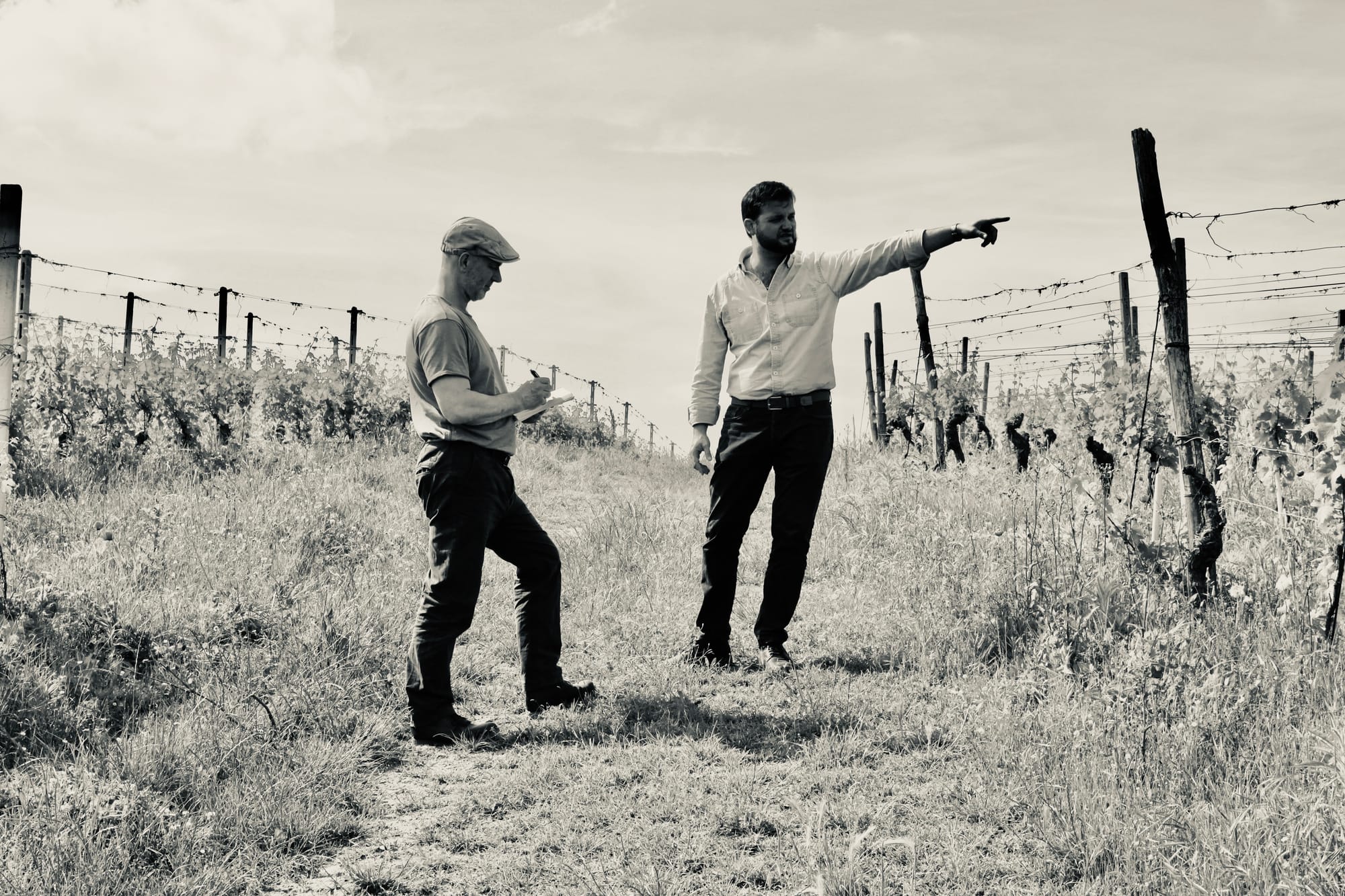
He crouches in front of the vine and pulls off the new shoots at the bottom of the stem. They are called "bastards" and need to be removed, since they grow very fast and draw nutrients meant for the rest of the vine.
When he reaches the first branch with small, new grapes, he leaves a large, older leaf to provide some shade for the grapes. At the same time, he avoids removing a younger baby leaf that has sprouted.
I wonder why he doesn't remove it. Wasn't the point to remove the new shoots? He explains that it’s one of the choices only a person can make, and that each vine must be trimmed by hand if one wants to make good wine.
The explanation is that a baby leaf is eager to grow, and when it's bigger in 15–20 days, it's capable of producing energy for the grapes next to it. It simply attracts nutrients from the stem and thus gets it into the habit of sending it in that direction.
Later in the year, the leaf is removed, and the surplus of nutrients goes to the grapes. The result is extra vigor in their growth at just the right time, achieving the desired quality of the wine.
"You have to tame the vine’s energy according to its age and the goals for the wine. A young vine has lots of energy but doesn’t know how to use it correctly. Therefore, it constantly needs to be guided in the right direction, much like raising a child," he says.
Freedom Is Crucial
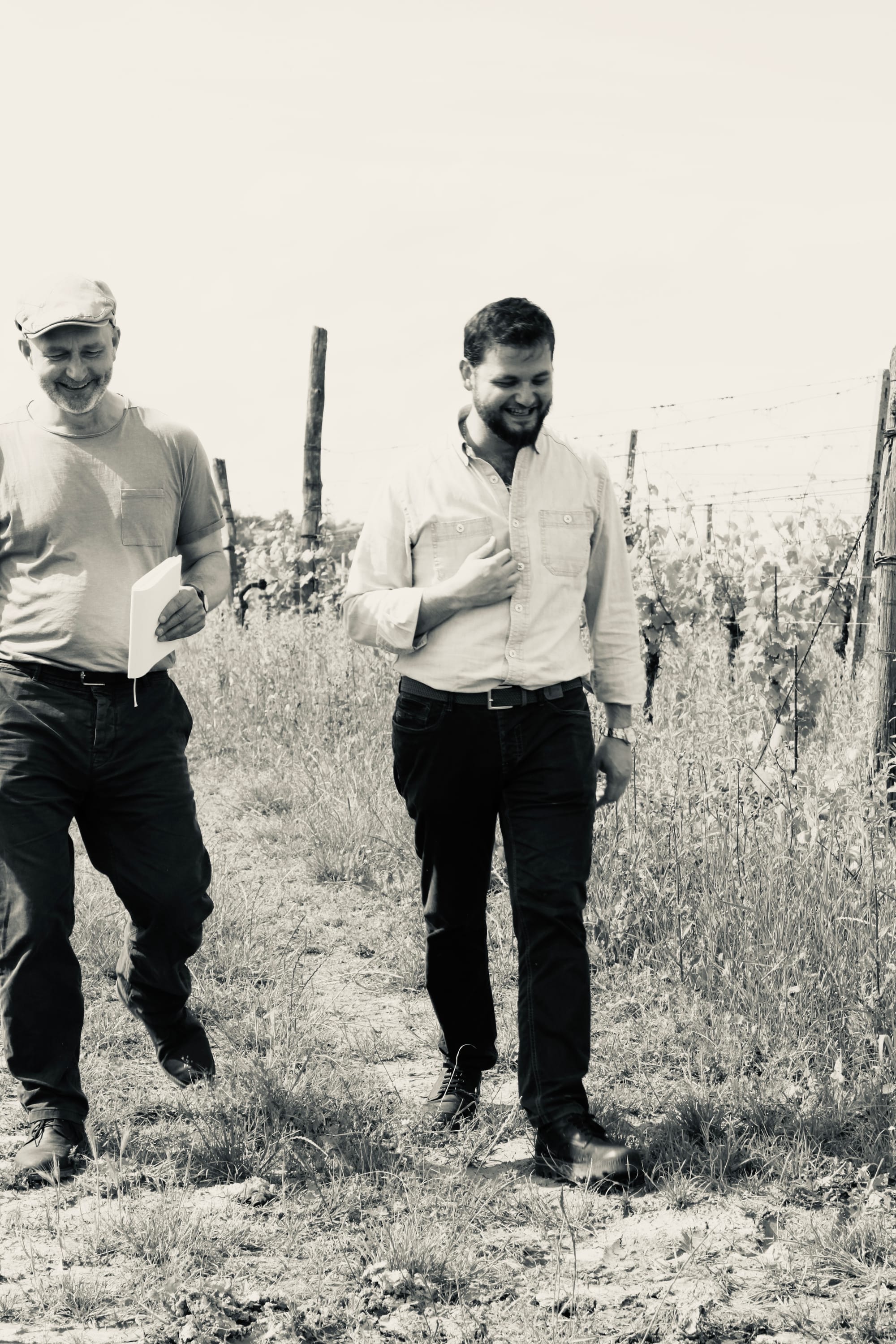
Gabriele Baldi shows me around the family vineyards, located south of Asti in Piedmont, northwest Italy. At 33, he is the sixth generation of a family of winemakers who have cultivated the land around Castel Burio since the mid-1800s, gradually acquiring it piece by piece. This process set the Baldi family free to make wine their own way.
"It took my family 35 years to save for the first small piece of land. After that, it went faster because we had income from both the work at the castle and our land, so only 30 years later, we had bought it all. Almost," he says, referring to the pact the family made with the three sisters who owned the castle.
It was 1914, and World War I was looming, leading to widespread impoverishment across Europe, including Piedmont. The sisters struggled to make ends meet and agreed with the Baldi family that they would care for them until they all passed away. Afterward, the family would receive the last piece of the castle's land as payment.
Gabriele uses the Italian word "Riscatto" for explanation. Directly translated, it means ransom, but it can also mean a form of liberation that brings about greater human release. That's how Gabriele understands the word. He likes it, he says, and values the principle behind it above all else because it is the foundation for the wine they make.
"When we, as a small wine producer, aim for the highest quality, we must have the freedom to make our own choices. Working in a way determined by others, with whom we may not agree, wouldn't allow us to create the wines we want. Our freedom is crucial," says Gabriele.
He sees it as his responsibility to carry the principle forward, with himself as the spearhead. Continuity is important to him, and for this reason, he has introduced a horizontal line in the middle of Baldi's wine labels. It symbolizes the consistency in cultivation and production of quality wine for which Baldi is known. This includes the family's relationship with nature, which they strive to establish a symbiosis with, for example, by being certified organic producers.
The Three V's
Gabriele explains his relationship with nature as a wine producer through what he calls "the three V's": vineyard, variety, and vintage. This combination is key, and the craft is to make them play together as naturally as possible.
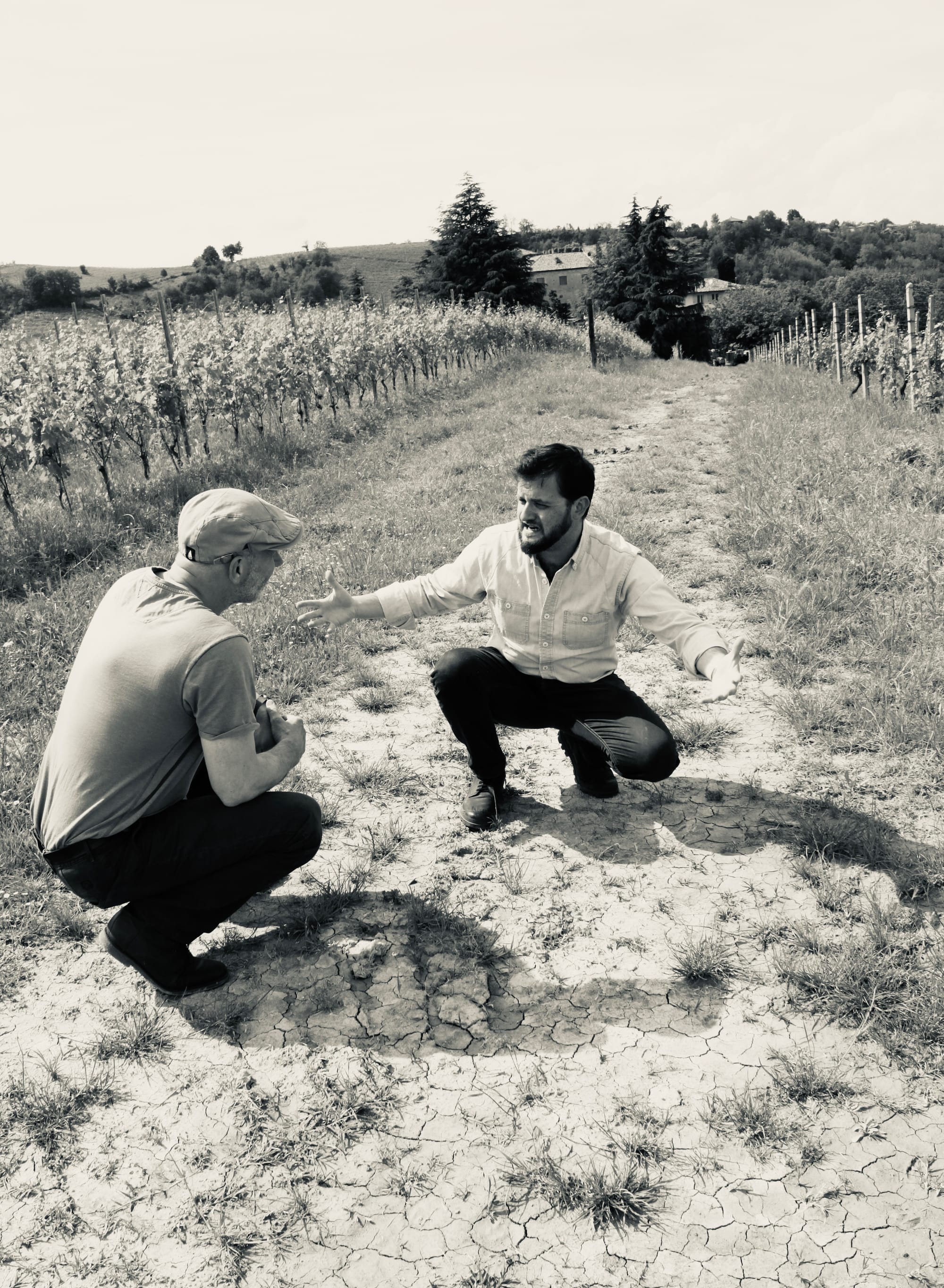
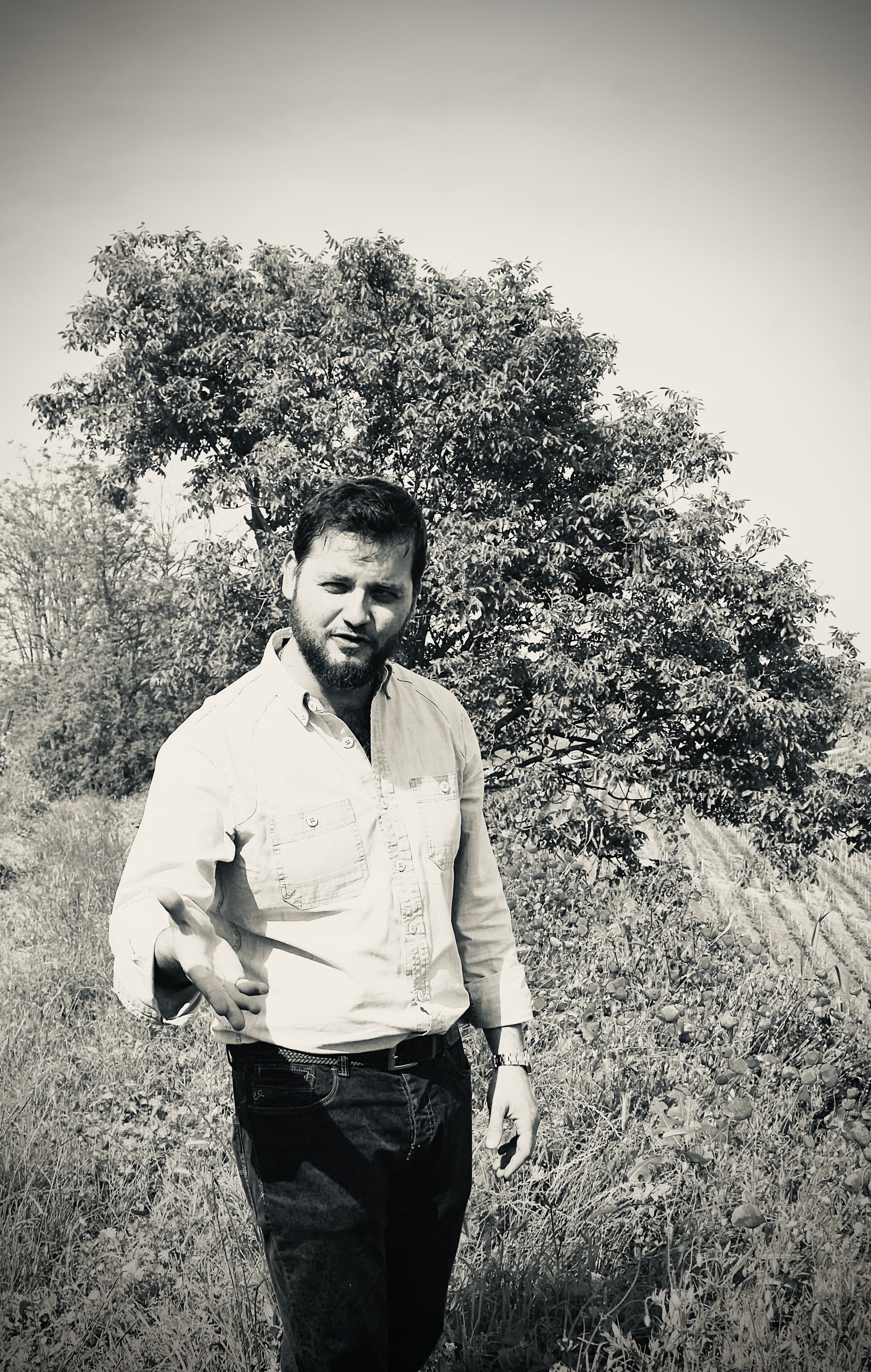
To illustrate his point, he takes me to the top of a long ridge behind the winery. There are vines on both sides, and we have a 360-degree view of the family's 14 hectares of vineyards. He turns toward the southeast slope, where a tractor track runs through the vines, effectively creating two separate vineyards on the slope.
"Take a closer look at the soil here," he says, pointing to two or three different spots in the tire tracks. "Can you see how the soil over here is marked by more moist spots, and over there it's drier, even though it just rained the same amount in both places?"
I nod, and he explains that it’s because the soil changes character depending on where we stand. On the left side of the tire track, the soil is more clayey, hence moister and heavier, while on the right side, it's lighter, airier, and more nutrient-rich. That's why they've placed the tractor track here. Even though it's on the same slope, nature has given them two very different vineyards to work with, requiring two different grape varieties. In this case, Barbera and Nebbiolo.
"Vines are like people. Some thrive best with peace and order, and others perform best under pressure. Nebbiolo is a grape variety that collapses under pressure. It needs nutrient-rich and light soil without surprises and unnecessary struggles, so we have it on the right side of the track. Barbera, on the other hand, works best under pressure, so we have it on the left side. Here, the vine roots have to struggle more to break through the clay and draw in nutrients," says Gabriele.
By the same principle, they have planted Moscato on the northeast side of the next hill, where the soil is also nutrient-rich and light but slightly cooler because it faces north. Moscato thrives in such conditions.
It can also be the same grape variety working well in different places, Gabriele explains. For instance, they have Barbera on the northeast slope of the hill we are standing on. Here, the soil has more chalk, which has the same effect as clay. But because the slope faces northeast, it’s cooler, producing a Barbera with higher acidity.
"It's about understanding the grape variety's needs concerning the opportunities the vineyard provides. Not all people are best served by learning to play the guitar. Some might need saxophone lessons instead," he says.
Climate Change Affecting Production
I ask about the third V, vintage. He shrugs and opens his arms, expressing that it’s the big unknown factor they can never control. Who knows how the weather will behave during the year? Their only option is to respond to nature’s whims as best as possible and still make good wine.
In this context, he mentions that the last two years have been very warm with only little rainfall, resulting in a production that is only half of what it usually is. Something that hurts a small wine producer economically, since it damages their liquidity and the investments they need to make in the vineyard from year to year.
Climate change is something that worries him greatly, as he, like all other winemakers, experiences extreme weather fluctuations that none of his family’s six generations have seen before. These are highly unusual conditions, and it’s very difficult to account for them because they are so unpredictable and extreme at the same time.
Nevertheless, he aims to optimize the vineyard’s production by increasing the number of bottles from 60 percent to 85 percent of the total harvest. Currently, Baldi sells 40 percent of their wine to other producers after the first fermentation in the tank. Not because the wine is flawed, but because it requires more capacity to utilize the entire production than they have.
“If we could increase production to 85 percent, I could hire one more person to work for us. That would be fantastic because, even though my father is in the vineyard every day, he is 70 years old and not getting any younger,” says Gabriele.
At the moment, there are around six people running the vineyard, depending on the time of the year. Besides Gabriele and his partner Salima, his father Pierfranco and mother Gisella are still working full-time. In addition, they have Gore the Macedonian as an employee and his wife Suzana, who also gives a hand on a daily basis.
For the harvest, they use a steady flock of local wine pickers. In particular, the legendary Angela, who is 81 years old. She lives in a house behind the ridge and has worked for the Baldi family all her life. No one can trim or harvest a vine faster than she can, even though she can now only do it with one hand due to her age.
The Pure Product
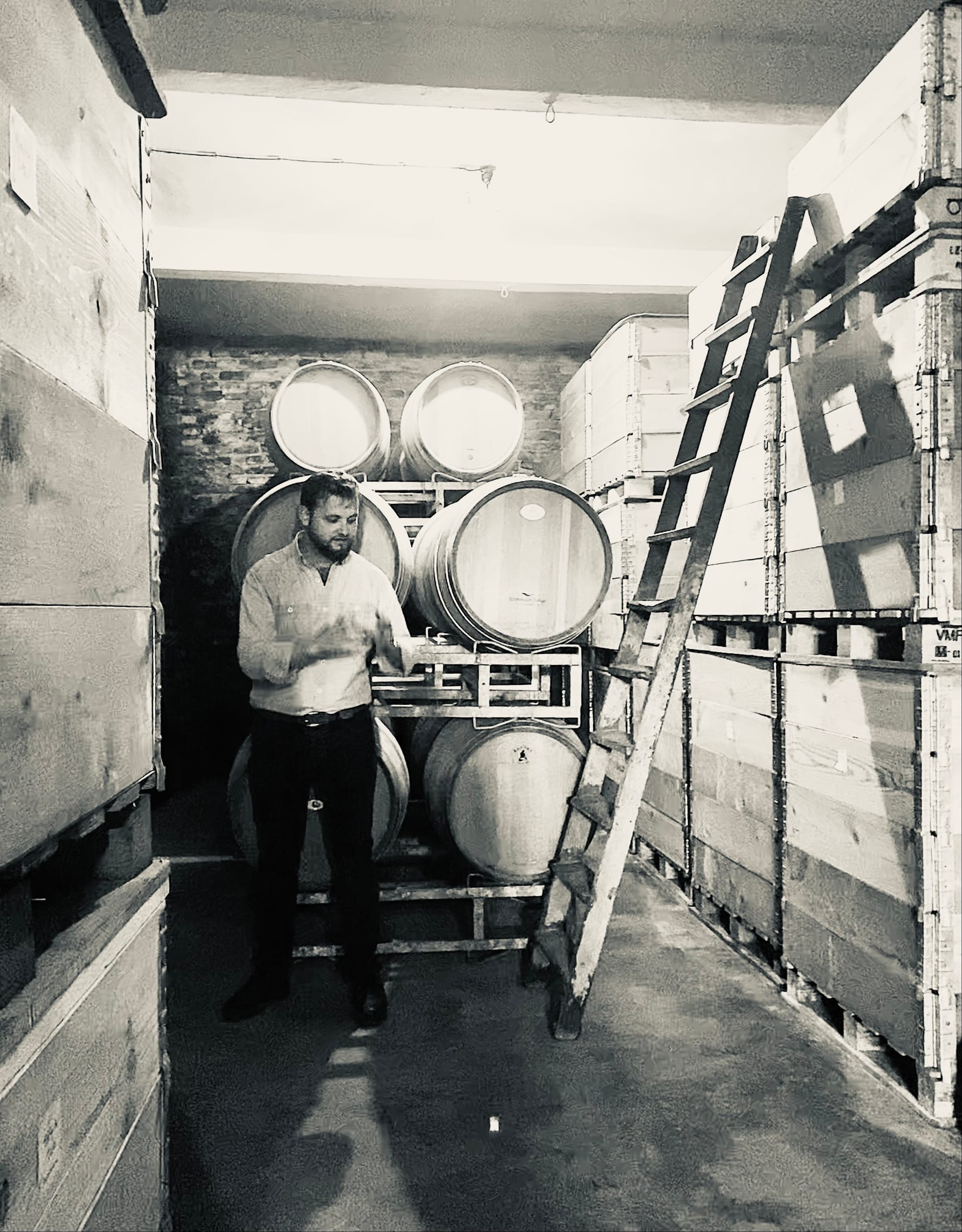
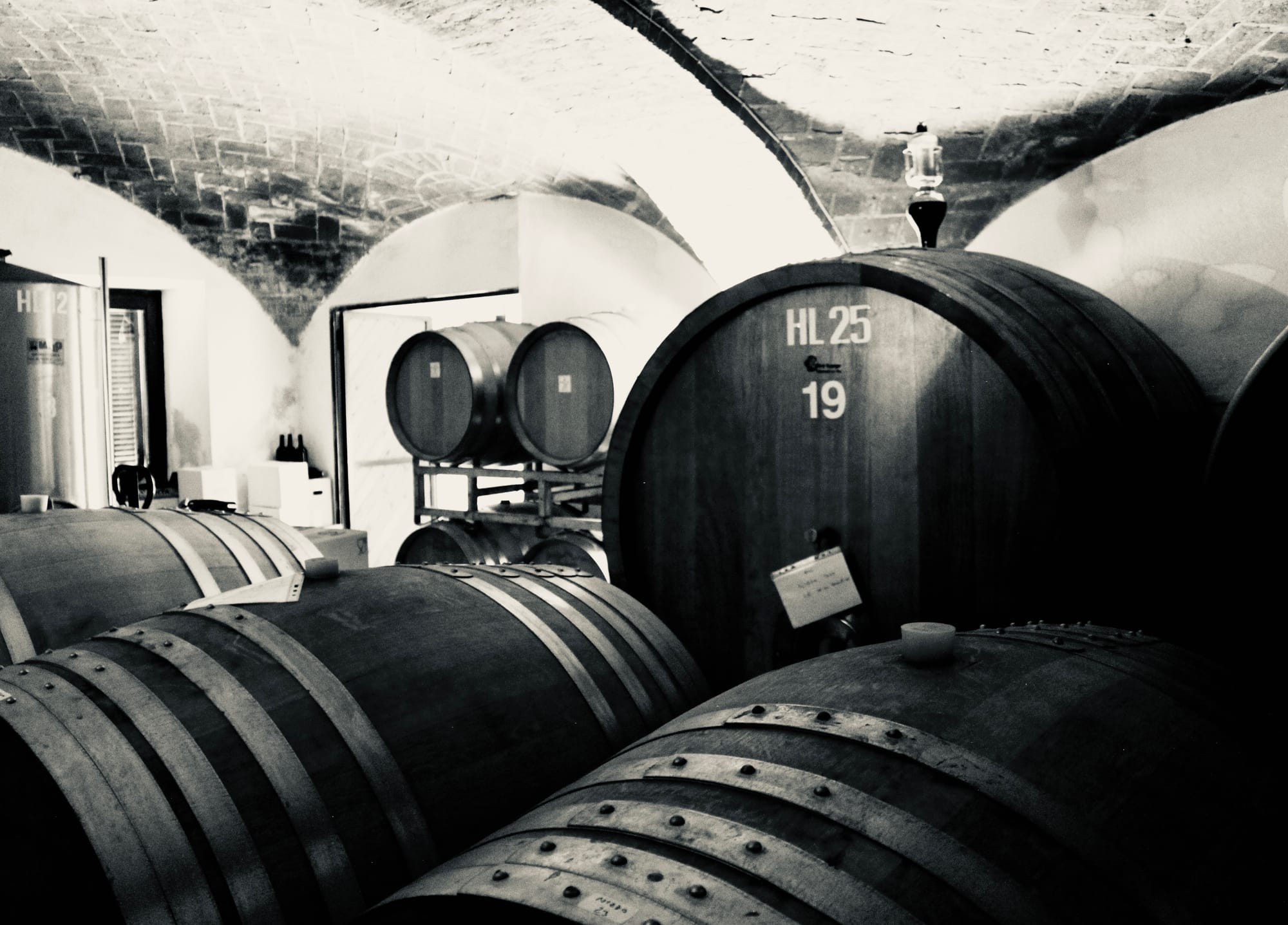
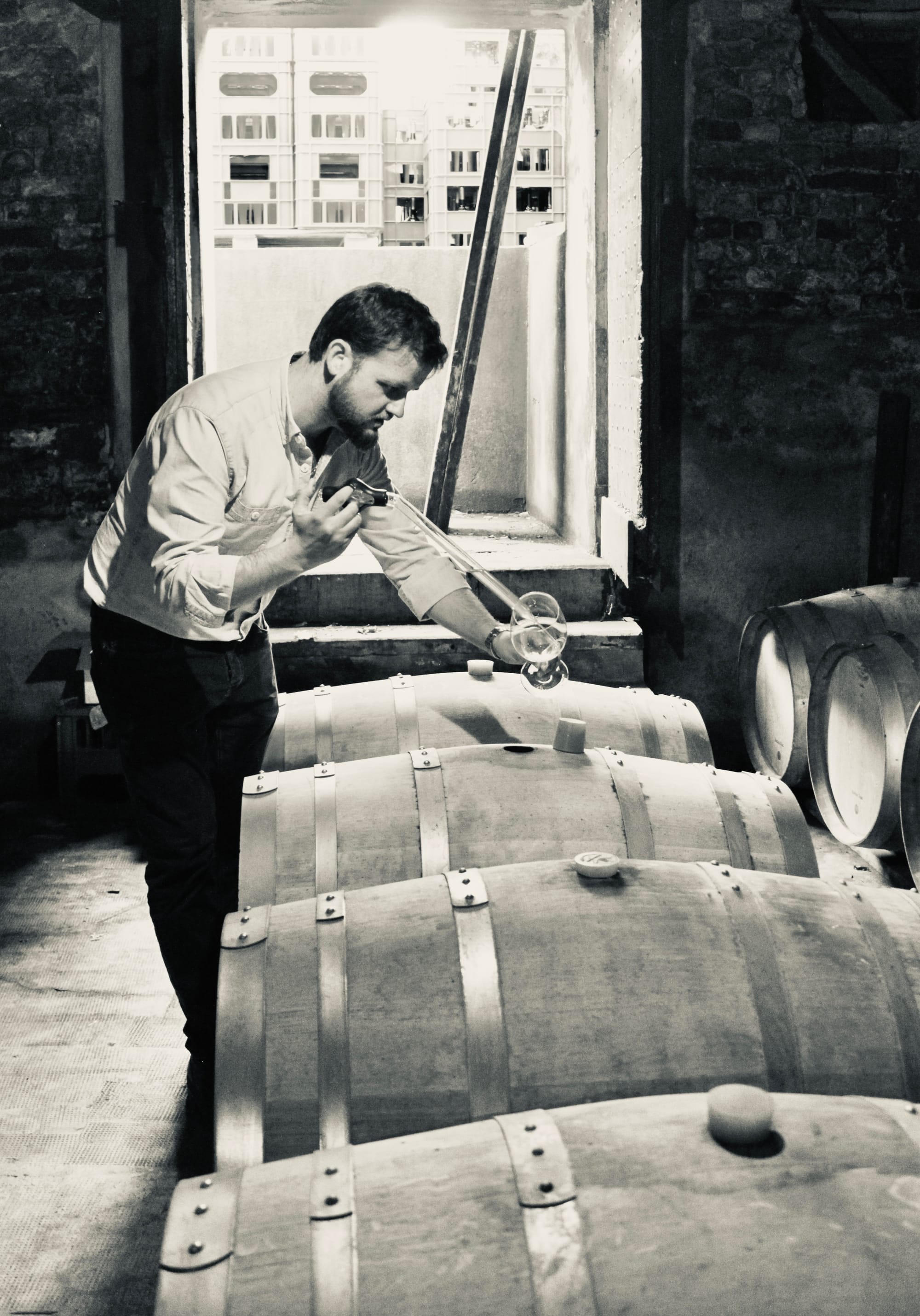
While we’ve been talking, we’ve moved from the vineyard to the cellar under the winery. Gabriele shows me last year's Puro, which will stay in barrique (small wooden barrels) for another month before being bottled.
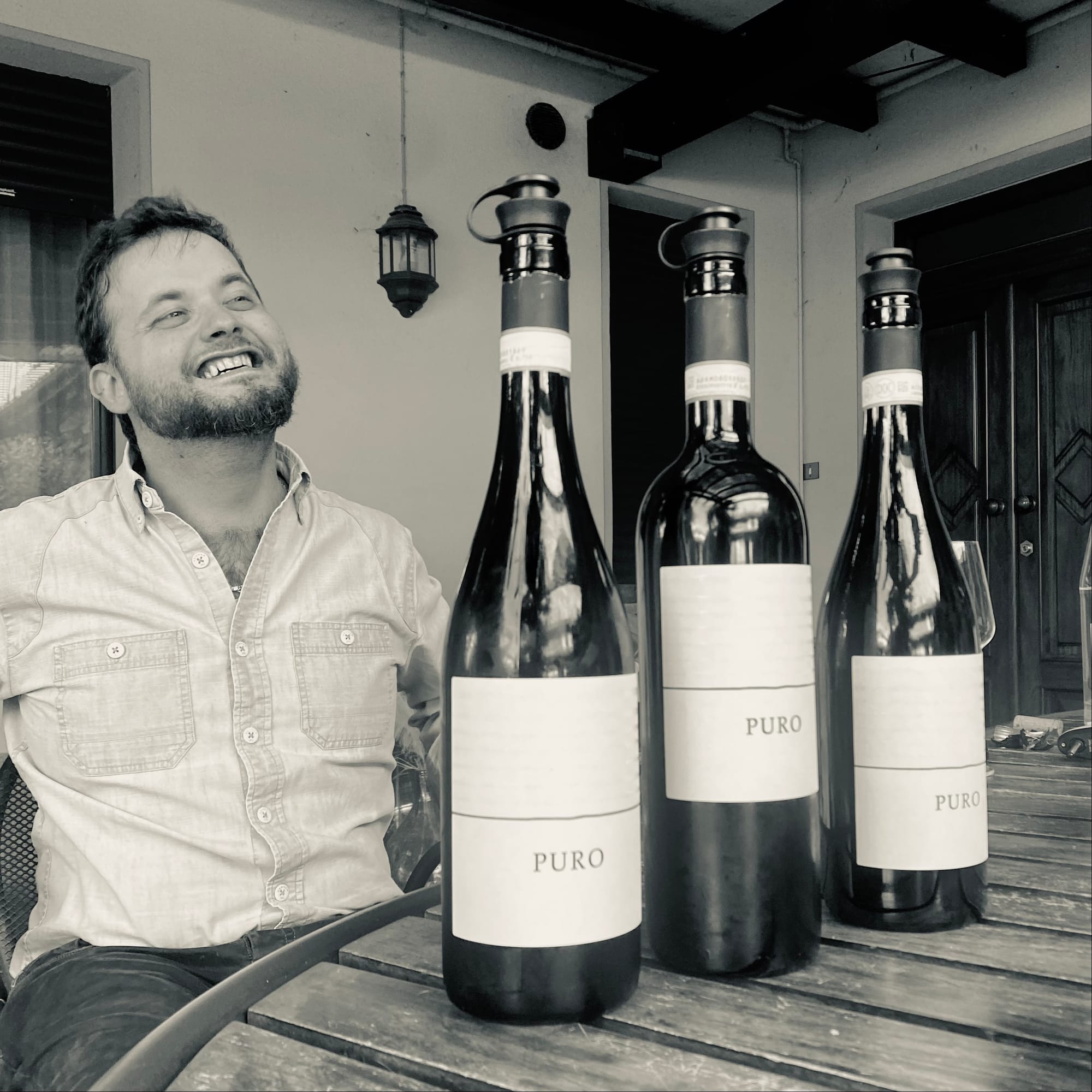
Puro is a white wine made from pure Chardonnay, which Baldi has had great success with abroad, especially in Asian markets like South Korea and Taiwan, where it's popular. It pairs well with the Asian cuisine, particularly the fish dishes.
In fact, Puro is doing so well that Gabriele expects to bottle 6000–7000 bottles of the new vintage, and he aims to increase its production next year.
As my eyes wander over the wooden barrels, I think about the many years of hard work behind the content of the 21 bariques of Puro. My gaze is supported by the smell of the wine cellar, with its combination of moisture, earth, stone, wood, and grape must. I like it. I am drawn to it. But for me, it’s only a brief, exotic glimpse into a world whose end product fascinates me. For Gabriele, it’s a raw daily routine driven by an inner calling across generations.
His point comes through and becomes real. Here in front of me lies the result of the three V's for Puro. A wine conceived and executed by Gabriele with the desire to create a unique wine in symbiosis with nature. Rooted in the craft he learned from his father and grandfather.
Purist or Artist?
I'm curious if he sees himself as a purist since he created this particular wine, but he dismisses it. He perceives himself more as a rationalist, using what Mother Nature gives him.
"It can quickly become pretentious to call oneself a purist, and I don't want that. I just want to make good wine. Nothing else. I think wine is the most fantastic product that can arise from the meeting between nature and man, but I'm not seeking a specific ideal," says Gabriele.
His humility and down-to-earth approach to making good wine are undeniable. Yet, I see him as more than a winemaker. Maybe it’s the perspective of the legacy he carries forward? Maybe it's his approach to the craft and symbiosis with nature? Or his reflective personality? I can't quite figure it out, so I approach it from another angle as we walk up from the cellar and into another room in the barn.
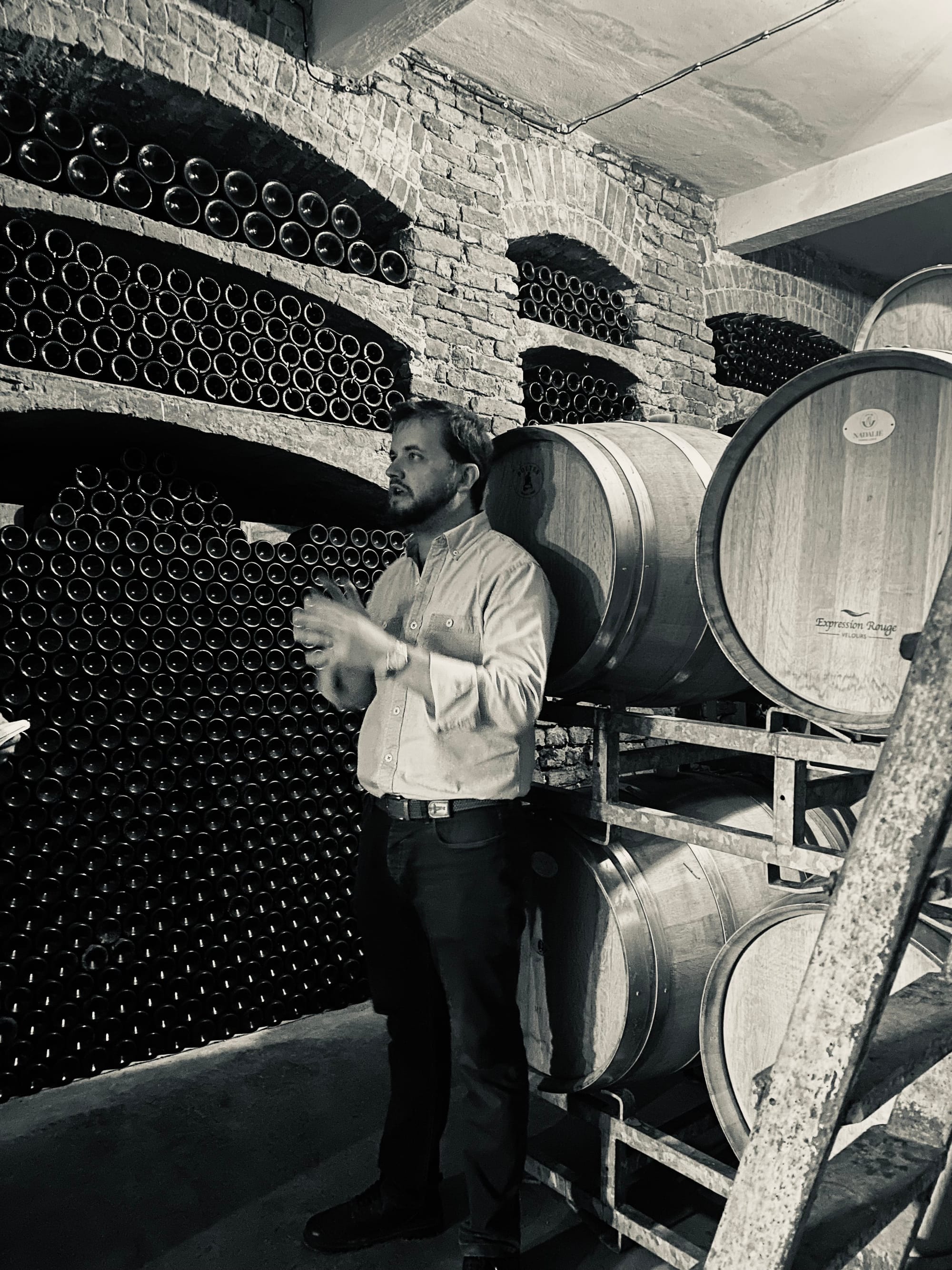
Some of the large wooden barrels with the red wines are standing side by side here, and he lets his hand brush over one as he walks by, as if it were a child he was stroking through the hair.
I refer to his earlier statement that he seeks beauty through his work by creating something that stands out. A typical motivation for an artistic nature. Does he see himself as an artist?
He leans against one of the large barrels and takes in the question. Reflects on it before answering. He says he's glad I see him that way and that it’s not entirely wrong, but it should be seen in another light. For if wine is art, then the vineyard is the artist. He is just the brush.
Piedmont as a Wine Region
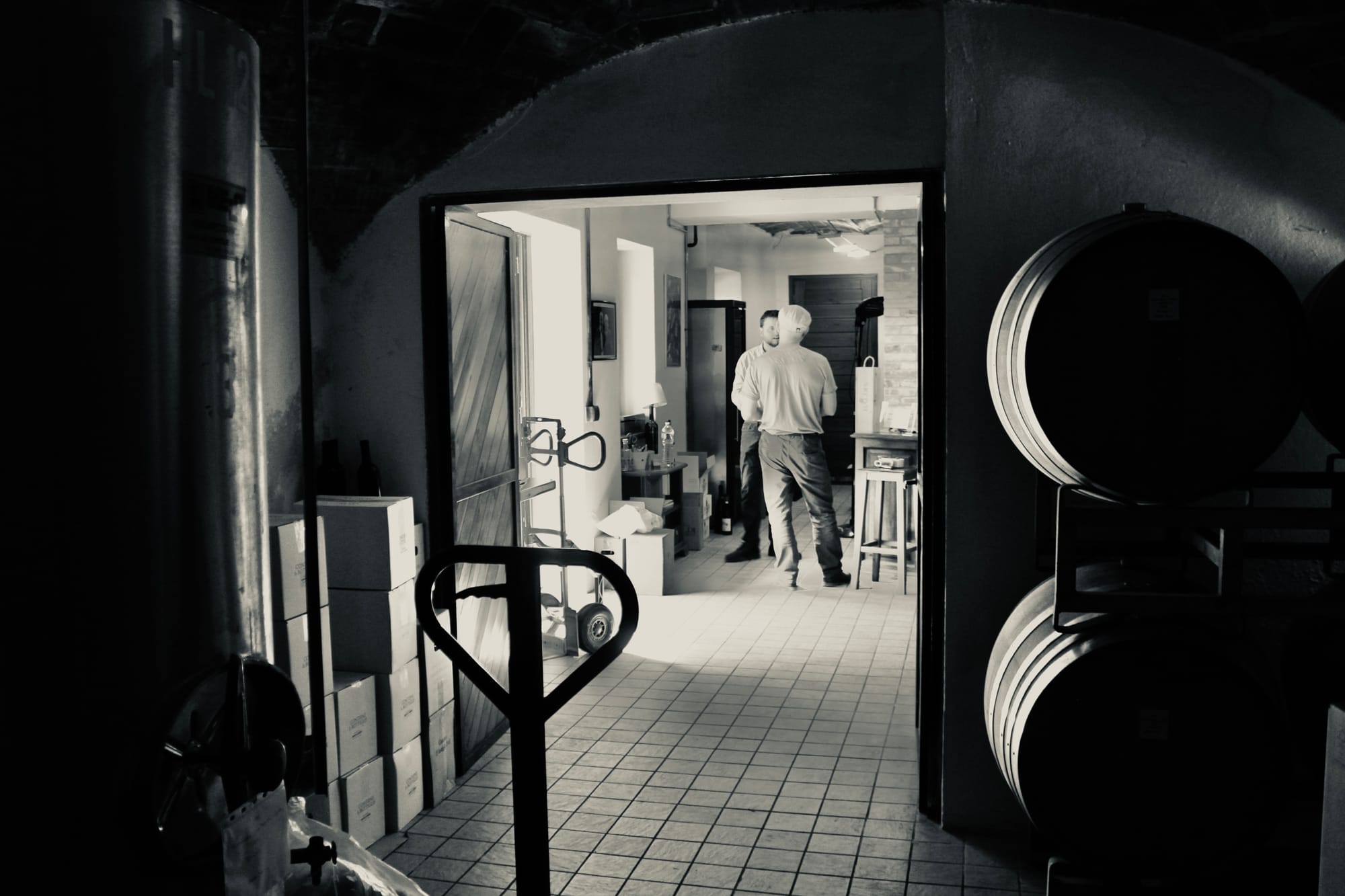
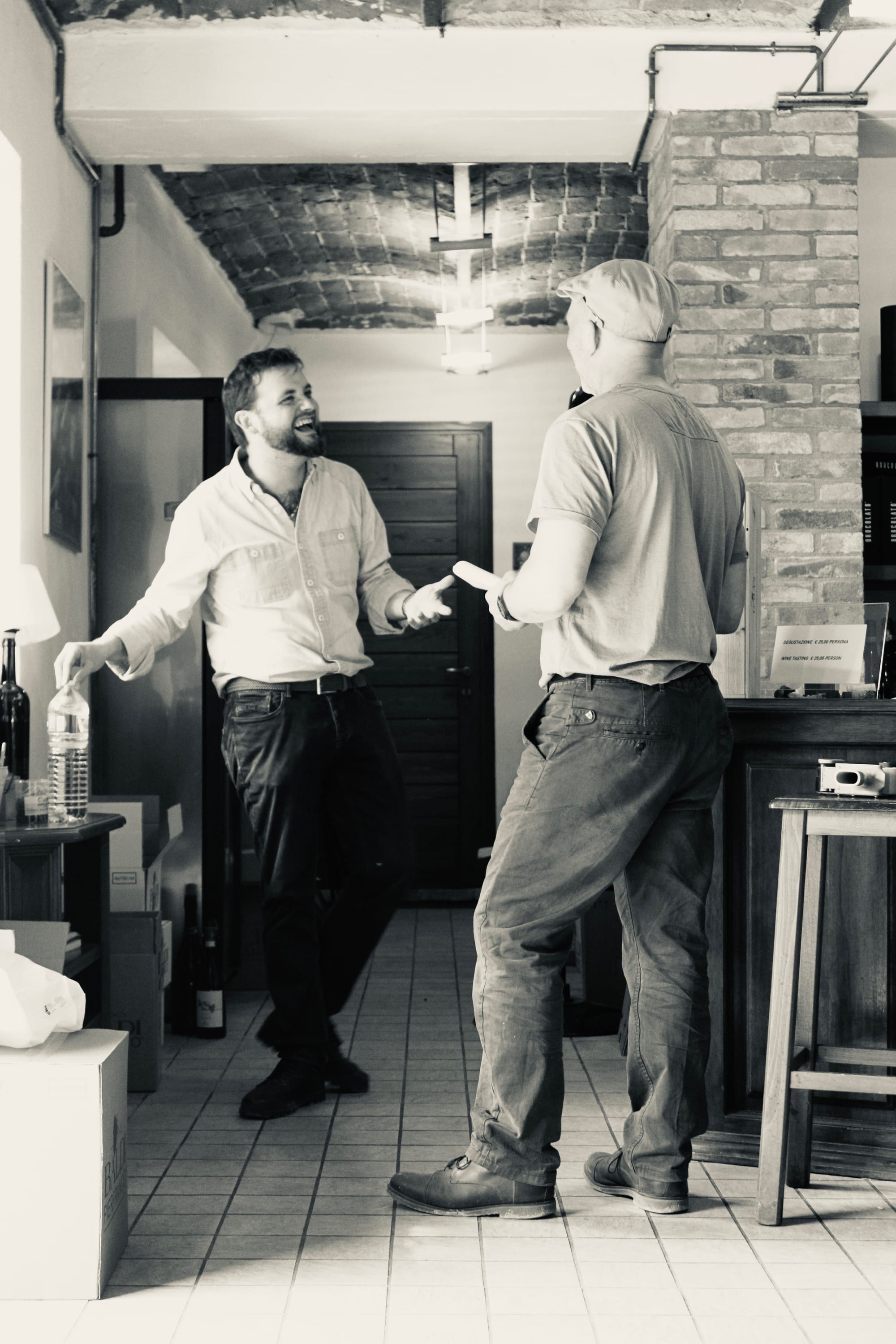
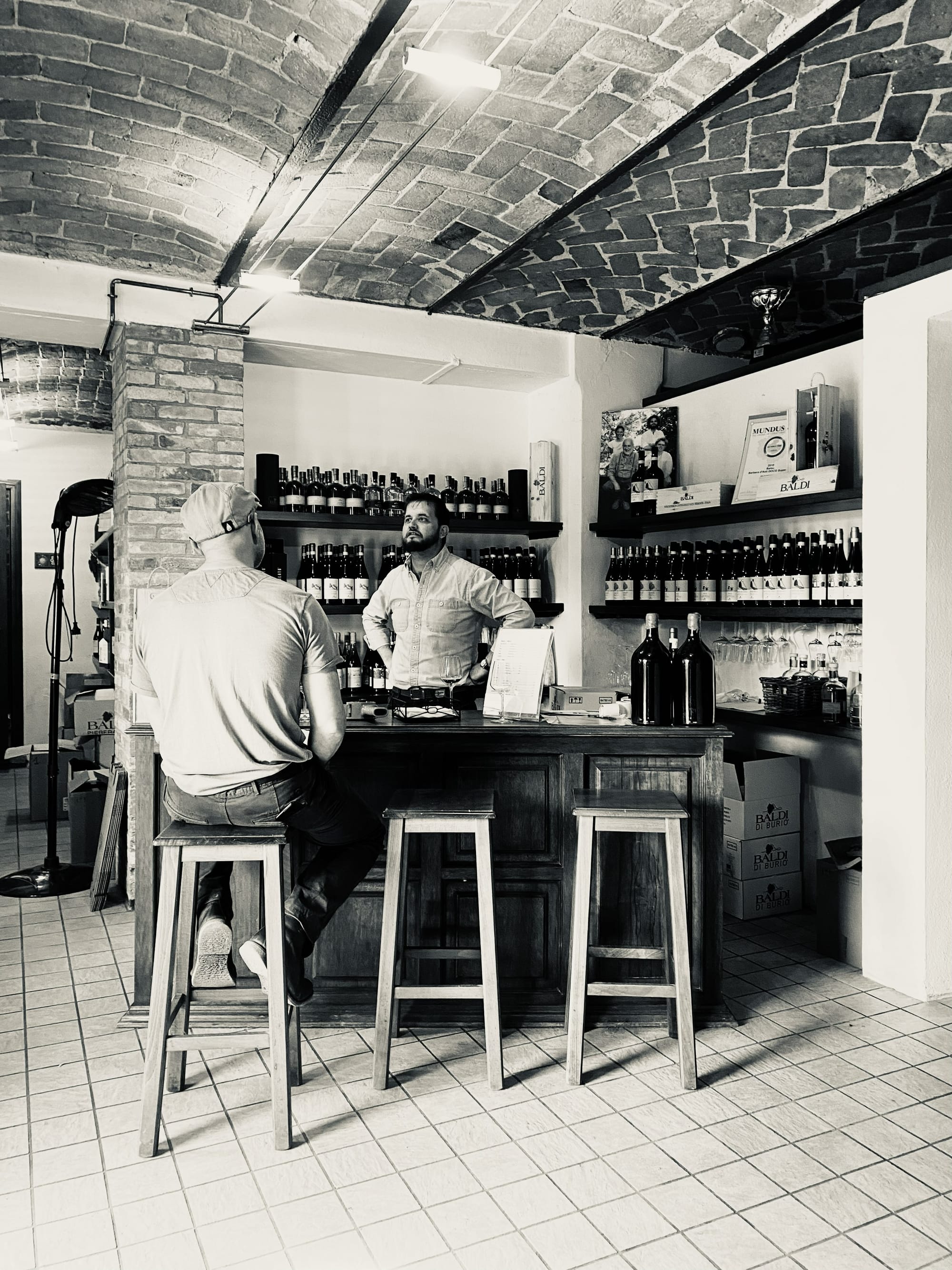
We go into the reception area and sit at the small wine bar the family has made for visitors to the vineyard. Something they greatly appreciate, as they see the communication of their wine as an important part of the work. Our conversation turns to Piedmont as a region and its significance for Italian wine, including the development that has taken place in the region in recent decades with an extraordinary focus on the Barbera grape.
“Thirty-five years ago, no one outside Italy drank Barbera wines, so it’s actually a bit of a revolution that has taken place. But it didn’t come out of nowhere,” says Gabriele, referring to the methanol scandal in 1985/86.
At the time, the wine growers in Piedmont used cheap red wine from Southern Italy to "correct" their cheap versions of Barbera, Nebbiolo, and Dolcetto wines. The South Italian wines had no elegance, but they had color and alcohol, and in the 80s, this was considered essential for the budget wines, which there was a great demand for.
Unfortunately, some local wine producers in the Barbera zone found it smarter to increase the amount of alcohol by adding the toxic ethanol to their wines instead. Most likely inspired by other wine producers in Italy who did the same in their regions, and so the scandal spread.
All together, the result was the deaths of 23 people, several people losing their sight, and more than 20,000 people getting seriously poisoned.
The scandal paralyzed both the production and export of Italian wine for years and led to the introduction of new control systems throughout the country.
As a consequence, a kind of silent defiance among wine producers in Piedmont arose, and each decided to show the world that they could make good wine with great aging potential. The subsequent 10–15 years were therefore dedicated to the innovation and refinement of the wines.
“Piedmont is a region where people are very individual, and everyone wanted to show that their wines stood out from the crowd in terms of quality. It somehow became a collective development process without anyone talking about it, but it gave us the position we have today. For when the international market in the late 1990s and early 2000s began to demand quality wines from Italy, we had already restructured the production and were ahead of the curve,” he says.
In that context, he sees Piedmontese wine maintaining its focus on high quality, both in Italy and around the world. At the same time, he hopes Piedmont does not achieve the same conditions as in Tuscany, where the flow of tourists to the vineyards are so massive that they have designed wine tastings similar to ordering food at a fast-food restaurant. It becomes too impersonal in his opinion, and that’s not where he wants the wine industry to go. For him, the human dimension is crucial for achieving a deeper understanding of the wine.
“People who come to me usually have a basic knowledge of wine, but they still want to learn something, and I see it as our role to help them with that,” says Gabriele.
However, he emphasizes that there is room for everyone. Even those who only buy very cheap or very expensive wine. In the end, the encounter with the wine will always lead to people wanting to know a little more about it and maybe also become better at tasting. All of which benefits the industry and its development as a whole.
A Clear Identity
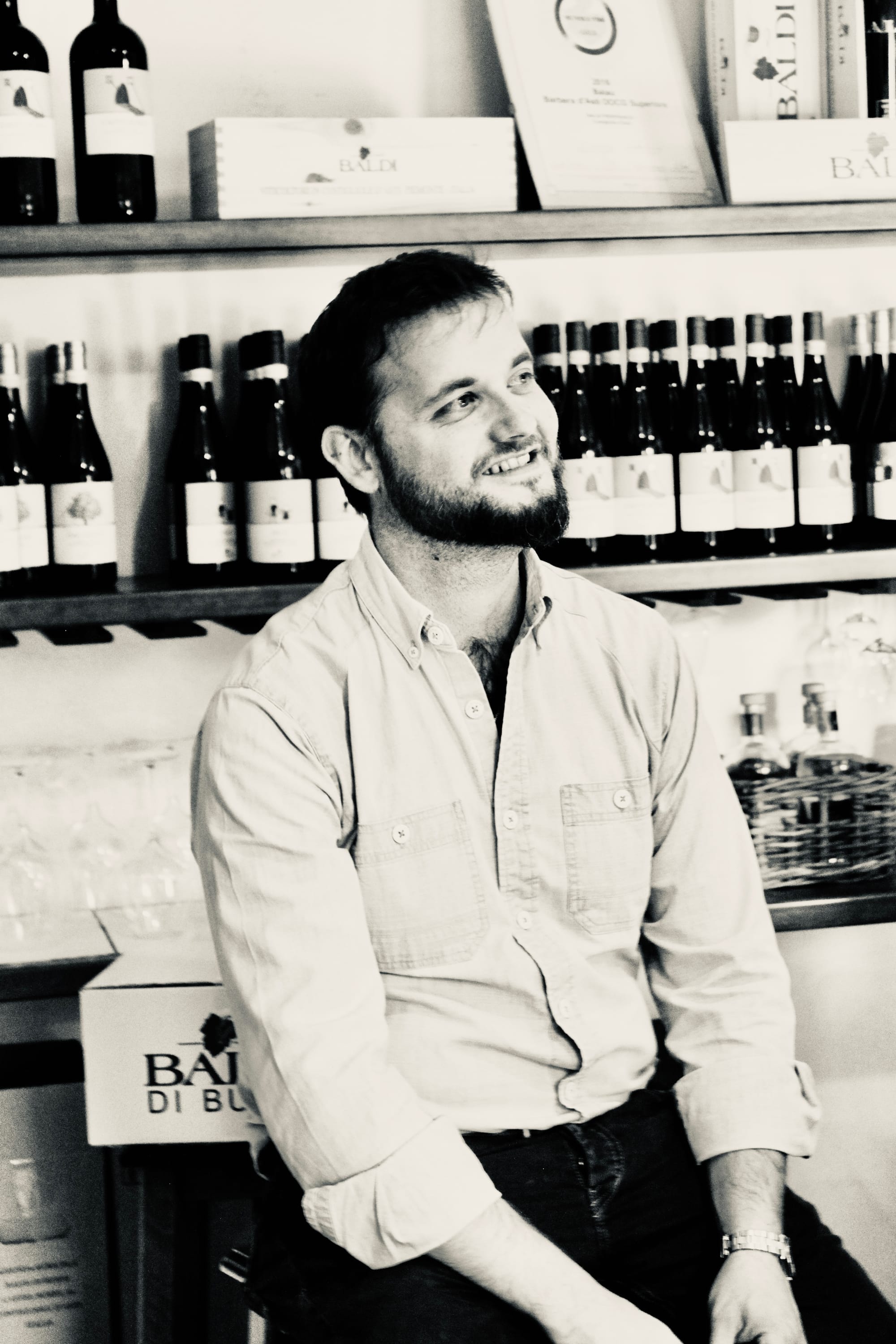
We step outside and sit at a table on the terrace between the barn and the Baldi family’s private residence. It’s late afternoon, and the sun is out for the first time in days, so the air is warm.
Gabriele asks what I would think of tasting four different vintages of Puro instead of the traditional tasting. Three of the vintages are from warm years, and the last one is from a cool year. He believes it will give me a good understanding of how much the weather and aging mean to the wine. I agree, and Gabriele fetches the samples, one of them taken directly from the bariques at the bottom of the cellar.
Shortly after, his father, Pierfranco, appears. He’s been in the field all day and is going in for his evening meal. He walks slightly bent over and limps on one hip with each step. A long life in the vineyard has left its marks, but his eyes shine with the joy of life, and he greets me with a warm and welcoming smile.
It is thanks to Pierfranco that Baldi has managed in a market that has undergone enormous changes over the last 40 years. He was one of the Piedmontese winegrowers who focused on making quality wines while at the same time making the production organic. A colossal task that demanded everything from him, but it is the foundation for the success Baldi has today.
It makes me think about how Gabriele sees his own role in the line of Baldi generations. What mark does he leave on the development of the vineyard moving forward?
He takes a long time to answer and says he hasn’t been asked before, so he doesn’t have a ready answer. But it has something to do with adding a clear identity.
“My father didn’t have time to stop and reflect on the vineyard’s identity, but I did, so that’s probably where my contribution is greatest. I simply asked the questions: How can we make our actions a concept? Why do we do what we do?” he says.
And the answer? Why does the Baldi family do what they do? Gabriele smiles, and his eyes light up like his father’s as the sentence leaves his lips.
“To be a brush.”
Photos by: Jacquiline Louise Holm